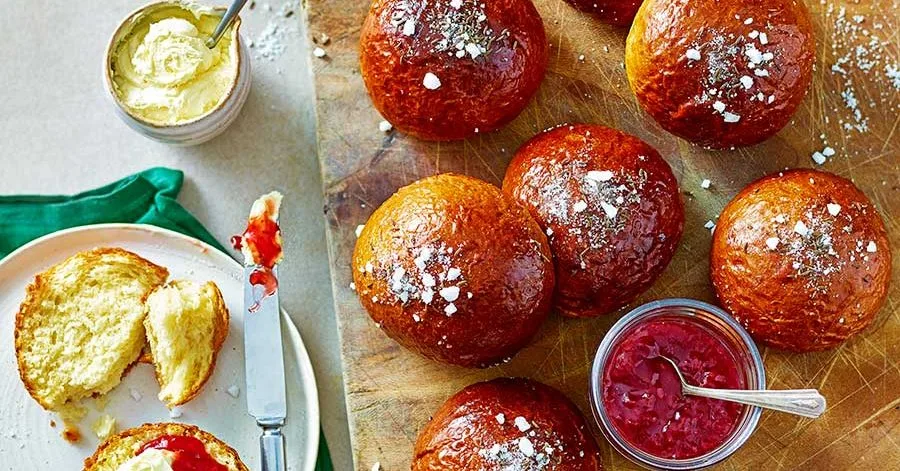
Classic Bath Buns
Per serving
Taste the British regional pride. Originating from the Roman city of Bath, the buns are best served with jam and clotted cream – and, of course, with tea.
Ingredients
12 serv.- whole milk↗300ml ml
- eggs↗3 medium
- strong wheat flour↗600g g
plus extra for dusting
- unsalted butter↗120g g
softened
- golden sugar↗80g g
- fast‑acting dry yeast↗7g sachet g
- sunflower oil↗
for rising
- clotted cream↗
and jam for serving
- golden sugar↗40g g
- cumin or fennel seeds1 ½ tsp tsp
- white sugar↗2 tbsp tbsp
pearls, or 3 white sugar cubes, crushed
Step-by-step instructions
- 1
Heat the milk in a small saucepan over low heat until it begins to steam, then let it cool for about 15 minutes until it is cool enough to the touch. Beat 2 eggs into the warm milk. Sift the flour into a bowl, then rub the butter in with your fingers until it resembles crumbs. Add the sugar and 1 tsp salt. Add the yeast, then make a well in the centre. Add the milk‑egg mixture with a wooden spoon until a sticky dough forms. Turn onto a flour‑dusted surface and knead for 10‑15 minutes until smooth, or use a mixer with a dough hook for 5 minutes. Transfer to an oiled bowl, cover with a kitchen towel and let rise for 1 hour, or until doubled in size.
- 2
Line two baking trays with parchment paper. Turn the dough onto the floured surface, knock out the air, then divide into 12 portions, weighing about 100 g each for accuracy. Shape into balls and place on the trays, leaving enough space between them. Cover with kitchen towels and let rise for another hour.
- 3
Preheat the oven to 200 °C/180 °C with convection/gas 6. Beat the remaining egg and brush the buns with it. Bake for 20‑25 minutes until they have risen and are golden‑brown. Transfer to a cooling rack.
- 4
For the glaze, place the golden sugar in a cup, add 20 ml of boiling water and stir until the sugar dissolves. Grind the cumin or fennel in a mortar.
- 5
While the buns are still warm, brush them with the sugar glaze, then sprinkle with sugar crystals and ground seeds. Enjoy warm with clotted cream and jam, or let them cool first. After cooling store in an airtight container for up to 48 hours.

The Prepka App Is Ready
All your recipes at your fingertips — in the Progressive Web App